
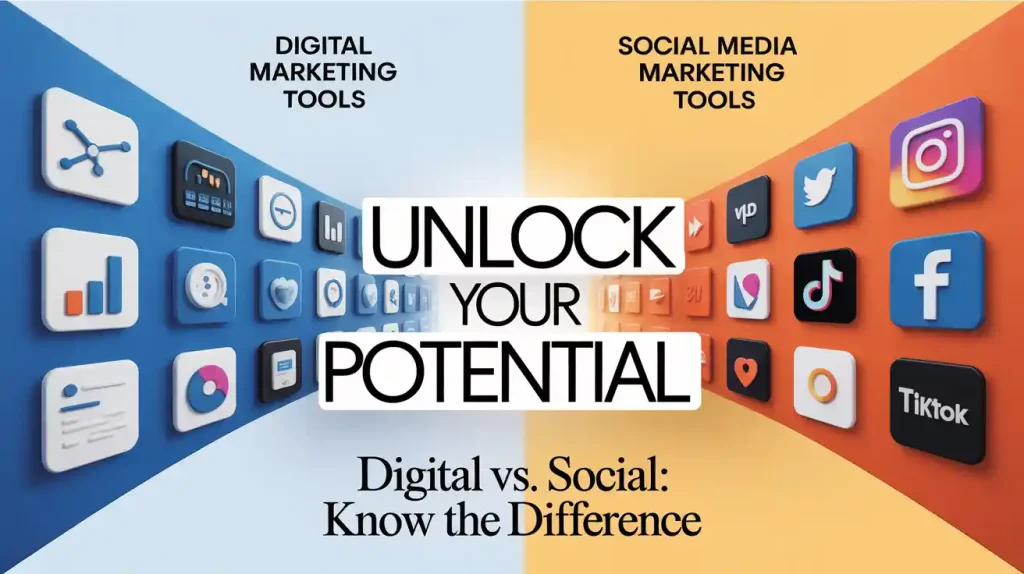
In the age of AI-driven strategies and hyper-personalized marketing, choosing the right set of tools can be the difference between growth and stagnation. Digital marketing and social media marketing are often used interchangeably, but their tools serve distinct purposes. This article breaks down their differences, explores top tools in each category, and helps you choose what’s best for your business in 2025.
What Are Digital Marketing Tools?
Digital marketing tools are software platforms or applications designed to support various aspects of online marketing—ranging from SEO and content marketing to email campaigns, PPC ads, and beyond. These tools aim to improve visibility, automate workflows, and deliver insights across multiple channels.
Common Features of Digital Marketing Tools
- Multi-channel campaign management
- Keyword tracking and SEO optimization
- Lead generation and CRM integration
- Analytics and A/B testing capabilities
- Content scheduling and performance tracking
Popular Digital Marketing Tools in 2025
- Semrush – for comprehensive SEO and content planning
- HubSpot – for inbound marketing, automation, and CRM
- Mailchimp – for email marketing and automation
- Google Analytics 4 – for tracking website performance
- Ahrefs – for backlink analysis and keyword tracking
Use Cases for Businesses
Businesses use digital marketing tools to:
- Drive traffic through SEO
- Nurture leads via email automation
- Launch PPC campaigns for targeted outreach
- Track campaign ROI and conversion rates
What Are Social Media Marketing Tools?
Social media marketing (SMM) tools focus exclusively on managing, optimizing, and analyzing marketing efforts across platforms like Facebook, Instagram, LinkedIn, and X (formerly Twitter). They help marketers publish content, engage with audiences, and track social performance metrics.
Core Functions of Social Media Marketing Tools
- Content scheduling and auto-posting
- Social listening and sentiment analysis
- Audience engagement and interaction tracking
- Influencer collaboration management
- Hashtag research and trend monitoring
Top Social Media Marketing Tools for 2025
- Buffer – for content scheduling and analytics
- Hootsuite – for multi-platform management and monitoring
- Sprout Social – for deep audience insights and engagement
- Later – especially strong for Instagram and TikTok
- Metricool – combines analytics with scheduling and hashtag tracking
Use Cases Across Platforms
- Managing brand voice across multiple channels
- Launching time-sensitive campaigns
- Analyzing competitor performance
- Building a community through consistent engagement
Digital Marketing Tools vs Social Media Marketing Tools: Key Differences
Let’s compare the two across major factors to clarify where they differ.
Scope and Purpose
- Digital marketing tools cover a broad spectrum of online strategies including SEO, email, paid ads, and more.
- Social media tools are platform-specific and focus solely on social channels and their engagement metrics.
Audience Targeting Capabilities
- Digital tools leverage cookies, email lists, and SEO keywords for broad targeting.
- Social media tools use real-time engagement, hashtags, and profile data for targeting.
Analytics and Reporting Features
- Digital marketing tools offer conversion tracking, funnel analytics, and ROI metrics.
- Social tools provide engagement metrics like likes, shares, impressions, and reach.
Integration with Other Marketing Channels
- Most digital marketing tools integrate across email, SEO, PPC, and even CRM platforms.
- Social tools often integrate with content calendars, AI copywriting tools, and influencer platforms.
How to Choose the Right Tool for Your Business
Both tool types are powerful, but choosing the right one depends on your strategy and goals.
Business Goals and Budget
If you’re focused on lead generation, SEO, and long-term growth—go with digital marketing tools. If brand awareness and engagement are your priority—lean into social tools.
Marketing Funnel Considerations
- Top of funnel (awareness): Social tools help increase visibility and engagement.
- Middle to bottom of funnel (conversion): Digital marketing tools guide users through nurturing sequences and targeted offers.
Scalability and Automation Features
For fast-growing businesses, tools like HubSpot or Sprout Social offer enterprise-level automation, collaboration, and reporting capabilities.
Future Trends in Digital and Social Media Marketing Tools
Role of AI and Automation
AI is streamlining content creation, predictive analytics, and even customer support. Expect deeper AI integration in both tool categories.
Privacy, Data Tracking, and Compliance
With changing privacy regulations (like GDPR and CCPA), tools now emphasize ethical data collection and transparent tracking.
Cross-Platform Integration and Omnichannel Marketing
Marketers are increasingly looking for unified dashboards to manage email, SEO, PPC, and social from one place—fueling a demand for hybrid solutions.
Final Thoughts
While digital marketing and social media marketing tools overlap, they serve different stages of the marketing funnel and fulfill unique business goals. For maximum effectiveness, many businesses are adopting a hybrid stack—leveraging the strengths of both to create a seamless, omnichannel marketing experience.
Evaluate your goals, budget, and team size before investing—and don’t be afraid to test and pivot as your strategy evolves.
Pingback: How AI Tools Are Transforming Social Media Marketing in the US – AIBlogWorld