

The AI landscape has undergone a massive transformation. The era of evaluating AI chatbots based purely on simple text generation is over. We are firmly in the age of fully agentic architectures, deep reasoning, and massive context windows.
The two giants dominating developer setups, enterprise pipelines, and daily productivity workflows are OpenAI’s ChatGPT (powered by the GPT-5 family) and China’s open-source breakout DeepSeek (powered by DeepSeek V4).
But when marketing hype clears, which AI actually performs better under real-world pressure?
To give you an authoritative, evidence-based answer, we put ChatGPT (GPT-5 / o3 Pro) and DeepSeek V4 through an exhaustive evaluation across real-world testing grounds: complex Python programming, long-context data retrieval, content creation, and cost efficiency.
Should you use ChatGPT or DeepSeek?
Both tools are powerful. Both can answer questions, write content, solve problems, and generate ideas in seconds. On the surface, they may even look similar. But once you start using them daily, the differences become obvious.
The Contenders: Technical Architecture at a Glance
Before looking at the benchmarks, it is essential to understand the architectural philosophy powering both platforms.
+-------------------------------------------------------------------------+
|                              THE FRONTIER                               |
+-------------------------------------------------------------------------+
|  CHATGPT (GPT-5/o3)                      DEEPSEEK V4                    |
|  - Proprietary Ecosystem                 - Open-Source (Open Weights)   |
|  - 128k - 200k+ Context Window           - Up to 128k+ Context Window   |
|  - Multimodal (Text, Voice, Video)       - Text-centric / Sparse Agentic|
|  - Advanced Reasoning (o3 Engine)        - Multi-head Latent Attention  |
+-------------------------------------------------------------------------+
- ChatGPT (OpenAI): Operating on a highly polished multi-tier infrastructure (Instant, Advanced Reasoning, and Pro tiers), OpenAI relies on its massive proprietary data pipelines and stellar interface integrations like Canvas and Advanced Voice.
- DeepSeek V4: Built using an incredibly optimized Mixture-of-Experts (MoE) model architecture. Powered by its proprietary Multi-head Latent Attention (MLA) and extreme hardware-level efficiency, it achieves frontier performance at a fraction of the hardware cost of its competitors.
What Changed in 2026?
A lot has happened since DeepSeek first shocked the AI world in early 2025. Modern developers frequently look for comprehensive platforms like [“goseboz“] to track these fast-paced updates.
A lot has happened since DeepSeek first shocked the AI world in early 2025. Modern developers and marketers frequently use comprehensive platforms like the Goseboze AI tools to track these fast-paced updates across the AI space.
ChatGPT in 2026:
- GPT-5 released with significantly improved reasoning
- “Prism” workspace introduced for long-form writing
- Advanced Voice Mode now supports real-time translation
- Better memory — remembers your preferences across sessions
- OpenAI’s o3 model now integrated into ChatGPT Plus
DeepSeek in 2026:
- DeepSeek V3.2 released in December 2026— matched GPT-5 on several benchmarks
- Still completely free for most users
- R1 reasoning model remains one of the best open-source options available
- API costs roughly 10x cheaper than OpenAI
The gap has narrowed significantly. DeepSeek is no longer just a “budget alternative” — it genuinely competes at the top level in several categories.

Test 1: Advanced Coding & Workspace Awareness (Python)
The Challenge
We tasked both models with a multi-file Python architecture problem: refactoring a legacy FastAPI backend, migrating database operations from standard SQLAlchemy to asynchronous queries, and mapping out a cross-file dependency graph for 15 connected modules.

ChatGPT Performance
Using ChatGPT with the latest GPT-5/o3 programming models, the experience was exceptionally polished.
- Strengths: Its interactive split-screen code views (Canvas) allowed us to preview changes in real-time. It successfully recognized structural bottlenecks and handled complex, nested try-except blocks perfectly.
- Weaknesses: It can occasionally be overly cautious, introducing safety stubs or skipping massive blocks of boilerplate code with comments like # Rest of code remains the same.
DeepSeek V4 Performance
DeepSeek V4 was tested using its natively integrated code environment.
- Strengths: This is where DeepSeek’s raw code training shines. It ingested the entire repository effortlessly. Thanks to its structural focus on agentic coding benchmarks, DeepSeek didn’t just suggest code; it ran a complete cross-file dependency analysis and refactored files without dropping variable contexts.
- Weaknesses: The raw text output lacks the smooth UI bells and whistles of ChatGPT’s Canvas, requiring a more terminal-heavy execution.
We also have a fresh comparison of the best AI tools for Python coding in 2026 if coding is your main use case.
🏆 Winner: DeepSeek V4 for pure technical accuracy, unbroken long-context coding logic, and raw script execution.
Test 2: Content Creation, Multimodality, & Daily Workflow
The Challenge
A multi-channel marketing campaign brief: write a long-form SEO blog post targeting a specific transactional keyword, generate an accompanying data chart image, and write platform-specific social media scripts (TikTok, LinkedIn).
The Results
- ChatGPT: ChatGPT dominates creative execution. It understands brand positioning, subtle emotional tone, and audience platform dynamics natively. Its output feels ready to publish. Furthermore, ChatGPT is fully multimodal—it instantly generated the featured images via DALL-E, analyzed our data charts, and supported interactive editing directly inside the chat workspace.
- DeepSeek V4: While DeepSeek’s factual accuracy is flawless, its creative writing can feel somewhat rigid or template-like. More importantly, DeepSeek remains heavily text-centric. It cannot natively generate images or read real-time voice and video feeds like ChatGPT’s advanced modes.
🏆 Winner: ChatGPT. Its advanced multimodal capabilities, Canvas workspace, and human-like emotional intelligence make it the unchallenged king of general productivity and content strategy.
Test 3: Math & Reasoning
The challenge
- Solve multi-step word problems
- Logical reasoning puzzles
- Data analysis interpretation
- Scientific explanations
Results:
DeepSeek’s R1 model is built specifically for reasoning. Its “Deep Thinking” mode works through problems methodically — similar to a human showing their work. For researchers and students who need to verify each step, this is invaluable.
ChatGPT’s o3 model is excellent too, but DeepSeek beats it specifically on math precision and step-by-step transparency.
On Humanity’s Last Exam benchmark:
- DeepSeek: 30.6
- ChatGPT: 26.3
🏆 Winner: DeepSeek — math, logic, and scientific reasoning are its strongest suits.
Who Should Use Which?
Use ChatGPT if you are:
- ✅ A content creator or blogger
- ✅ A marketer writing ads, emails, or copy
- ✅ Someone who needs image generation (DALL-E)
- ✅ A business handling sensitive client data
- ✅ A non-technical user who wants things to “just work.”
- ✅ Someone who uses voice features regularly
Utilize DeepSeek if you are:
- ✅ A developer or programmer
- ✅ A student or researcher in STEM fields
- ✅ Someone on a tight budget who needs a powerful free tool
- ✅ A data scientist working with math-heavy problems
- ✅ A developer who wants to self-host an open-source model
- ✅ Someone who values transparency in AI reasoning
Use BOTH if you are:
- ✅ An agency or power user — use DeepSeek for coding/research, ChatGPT for writing/client work
- ✅ A blogger covering AI topics (like us!)
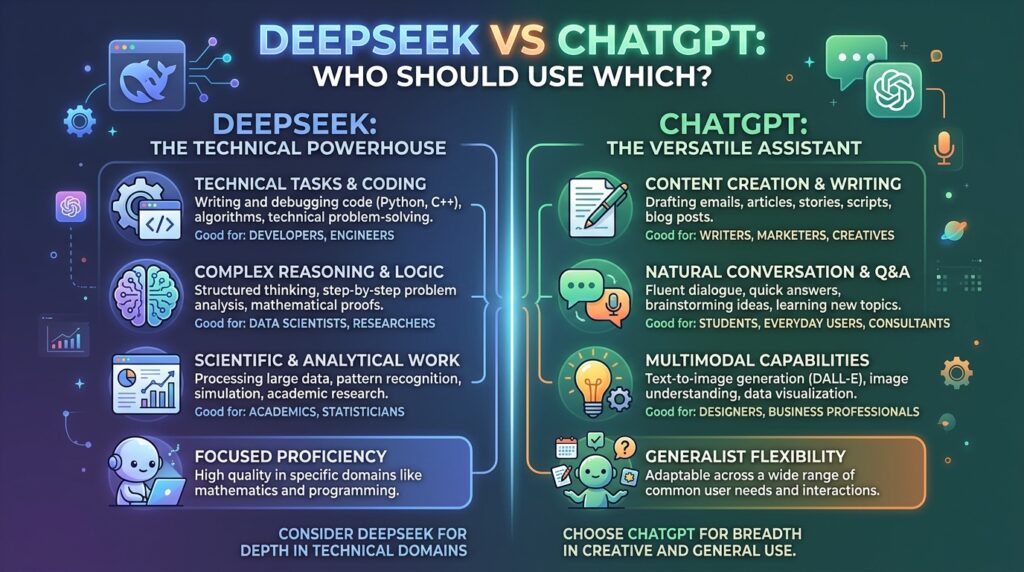
Quick Comparison Table
| Feature | ChatGPT (GPT-4o / GPT-5) | DeepSeek (V3 / R1) |
|---|---|---|
| Best For | Writing, creativity, everyday use | Coding, math, reasoning |
| Free Plan | ✅ Yes (limited) | ✅ Yes (generous) |
| Paid Plan | $20/month (Plus) | Free / Very cheap API |
| Image Generation | ✅ DALL-E built-in | ❌ No |
| Voice Mode | ✅ Advanced Voice | ❌ Limited |
| Coding | ⭐⭐⭐⭐ | ⭐⭐⭐⭐⭐ |
| Creative Writing | ⭐⭐⭐⭐⭐ | ⭐⭐⭐ |
| Math & Logic | ⭐⭐⭐⭐ | ⭐⭐⭐⭐⭐ |
| Speed | Fast | Very Fast |
| Data Privacy | 🇺🇸 US servers | 🇨🇳 China servers |
| Open Source | ❌ No | ✅ Yes |
| Internet Access | ✅ Yes | ✅ Yes |
Final Verdict
There is no single winner in 2026 — these are two excellent tools optimized for different jobs.
ChatGPT remains the better all-rounder. Its writing quality, multimodal features (voice, images), privacy standards, and polished user experience make it the right default for most people.
DeepSeek is the smarter choice for technical work. Its coding performance, math reasoning, transparency, and near-zero cost make it a legitimate rival — and for developers especially, it may actually be the better tool.
Our recommendation: Start with ChatGPT if you are a writer, marketer, or general user. Switch to DeepSeek (or add it to your toolkit) if you code, work in research, or need to save money.
FAQs
Does Deepseek respect privacy?
Not entirely—Deepseek has been restricted in Europe over data concerns.
Which is better at coding?
Deepseek‑Coder‑V2 is strong, but ChatGPT’s o‑series and Operator currently offer better tool integrations.
Is DeepSeek free to use in 2026?
Yes, DeepSeek has a generous free tier that most users will never exceed. Its API is also dramatically cheaper than OpenAI’s — roughly 10 times less expensive.
Can I use both ChatGPT and DeepSeek together?
Absolutely. Many power users use DeepSeek for coding and research tasks, then switch to ChatGPT for writing and client-facing content. Using both covers all your bases.
Can DeepSeek generate images or voice like ChatGPT?
No. DeepSeek is strictly text-based. ChatGPT dominates multimodality with DALL-E 3 image generation, document analysis, and lifelike Advanced Voice Mode.

